

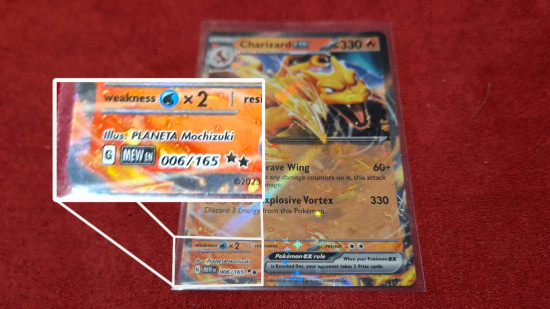
Welcome to the exciting world of Pokémon card collecting! Whether you’ve just opened your first booster pack or you’re rediscovering a childhood hobby, one of the first things you’ll notice is the small symbol at the bottom of each card. This symbol is the key to understanding a card’s rarity and is a crucial piece of knowledge for any collector.
With the introduction of new rarities in the Scarlet & Violet era and the continuation of these styles into the new Mega Evolution series, there’s never been a better time to learn what you’re looking for. This guide will break down the rarity symbols you’ll find in modern Pokémon TCG sets.
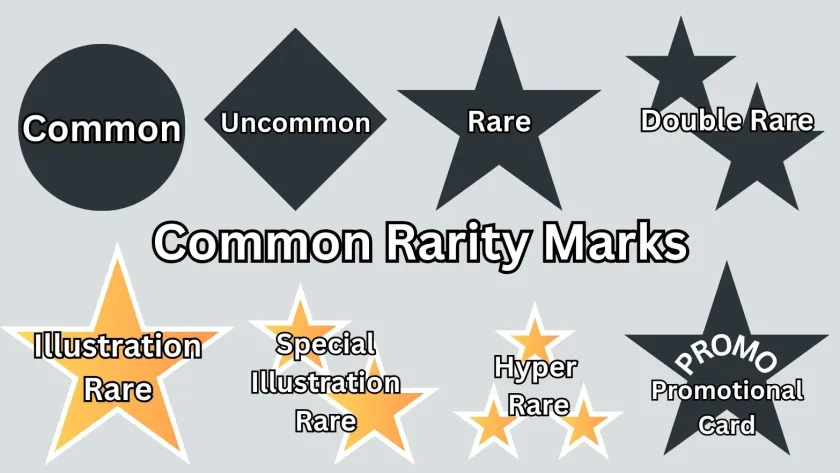
The Basics: Common, Uncommon, and Rare
These three rarities have been the foundation of the Pokémon TCG for decades. You’ll find multiples of these in almost every booster pack.
● Circle: Common As the name suggests, these are the most frequently found cards. They typically feature Basic or Stage 1 Pokémon that are essential for playing the game but are not usually valuable from a collector’s standpoint.
◆ Diamond: Uncommon Slightly harder to find than Commons, these cards often include useful Trainer cards and more powerful Stage 1 or Stage 2 Pokémon. They are the workhorses of many playable decks.
★ Star: Rare Every booster pack will typically contain at least one “Rare” card. These are standard Pokémon, often in their final evolution, that don’t have any special holographic treatment.
The Holos: Adding Some Shine
This is where collecting starts to get more exciting. Holofoil (or “holo”) cards have a shiny, reflective layer on the artwork.
★ Star: Holo Rare These cards have the same black star symbol as a standard Rare, but the image of the Pokémon is holographic. You can expect to find one of these in every few packs.
The Ultra Rares: Power and Prestige
“Ultra Rare” is a broad term for a variety of powerful and sought-after cards, all of which are holographic. In modern sets, these are distinguished by having two rarity stars instead of one.
★★ Double Black Stars: Double Rare (e.g., Pokémon ex) These are powerful Pokémon, like the new Mega Evolution ex cards, that form the centerpiece of many decks. The entire card is holographic, and they are significantly harder to pull than a standard Holo Rare. The “ex” mechanic means your opponent takes extra Prize cards when they’re knocked out, so they come with high risk and high reward.
★★ Double White Stars: Ultra Rare (Full Art / Trainer) These cards are true works of art. An Ultra Rare “Full Art” card features artwork that covers the entire card, often with a unique texture you can feel. In the Mega Evolution set, this category includes powerful Pokémon ex and popular Trainer cards.
The Secret Rares: The Ultimate Chase
These are the rarest and often most valuable cards in a set. They are called “Secret” because their card number exceeds the official set number (for example, 201/188).
★★ Two Gold Stars: Special Illustration Rare (SIR) Considered the ultimate prize for most modern collectors, Special Illustration Rares feature stunning, unique, full-card artwork that often tells a story or shows the Pokémon in its natural environment. Cards like the Mega Venusaur ex from Mega Evolution fall into this category and are highly sought after by both collectors and players.
★ One Gold Star: Illustration Rare (IR) Similar to SIRs, Illustration Rares feature beautiful full-card artwork. They are typically less rare than their “Special” counterparts but are still a fantastic and valuable pull that collectors love. They are distinguished by a single gold star symbol.
★★★ Three Gold Stars: Hyper Rare (Gold) The pinnacle of rarity, these “gold cards” feature a Pokémon or Trainer card embossed with a gold finish. In the new MEGA era, there is also a new “Mega Ultra Rare” (MUR) rarity for certain gold cards, featuring unique artwork not seen on other versions of the card.
Now that you know your symbols, take another look through your collection! You might have some hidden gems. Ready to find more?(https://www.cardplustcg.com) at CardPlusTCG today. Happy collecting!